
Table of Contents
CASE STUDY — 49-Ton Cold Press Machine Rigging, Nhon Trach 5 Industrial Zone
Location: Nhon Trach 5 Industrial Zone, Dong Nai Completed: June 2023 Service: Machinery rigging and positioning — client name available on request / confirm permission to publish
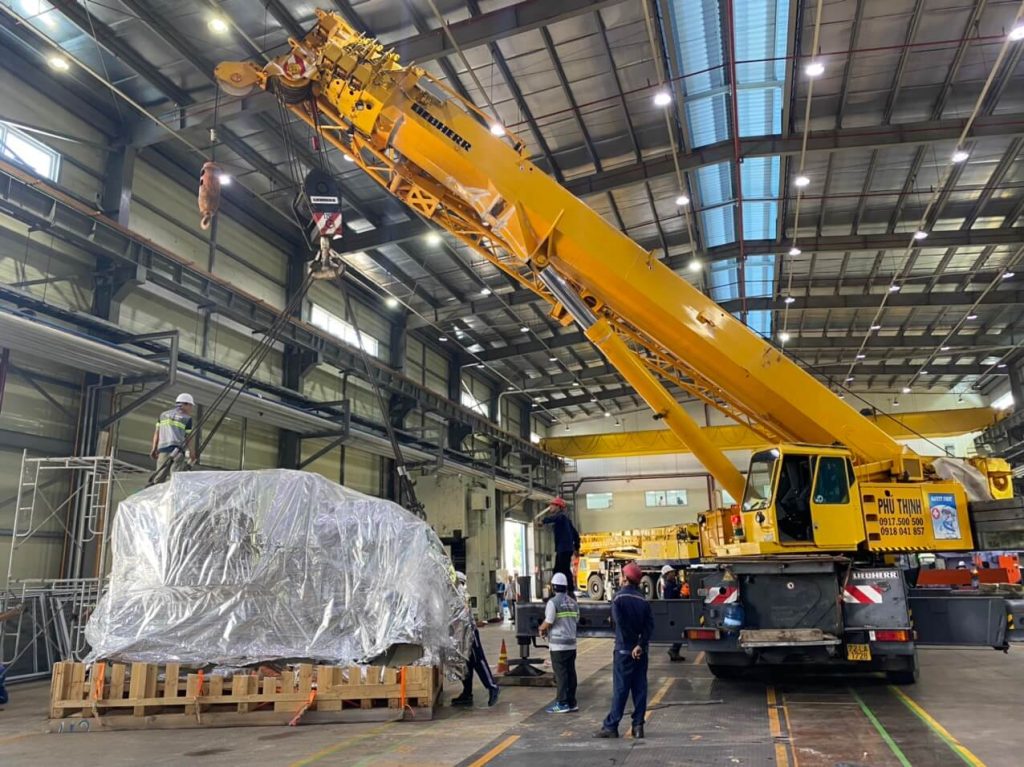
Mobile crane lifting 49-ton cold press machine at Nhon Trach 5 Industrial Zone
I. Project Overview
A manufacturing client at Nhon Trach 5 Industrial Zone needed a GW 49-ton cold press machine — a 25-ton piece of equipment measuring 4.5 × 2.5 × 2.8 meters — lifted from its delivery position, rotated from horizontal to vertical orientation, and installed at its final production-line location inside the facility.
This is a job where the margin for error is measured in millimeters, not centimeters. A 25-ton machine reorienting from horizontal to vertical mid-lift generates a shifting center of gravity that a standard forklift move cannot safely manage — it calls for calculated rigging, not brute lifting capacity.
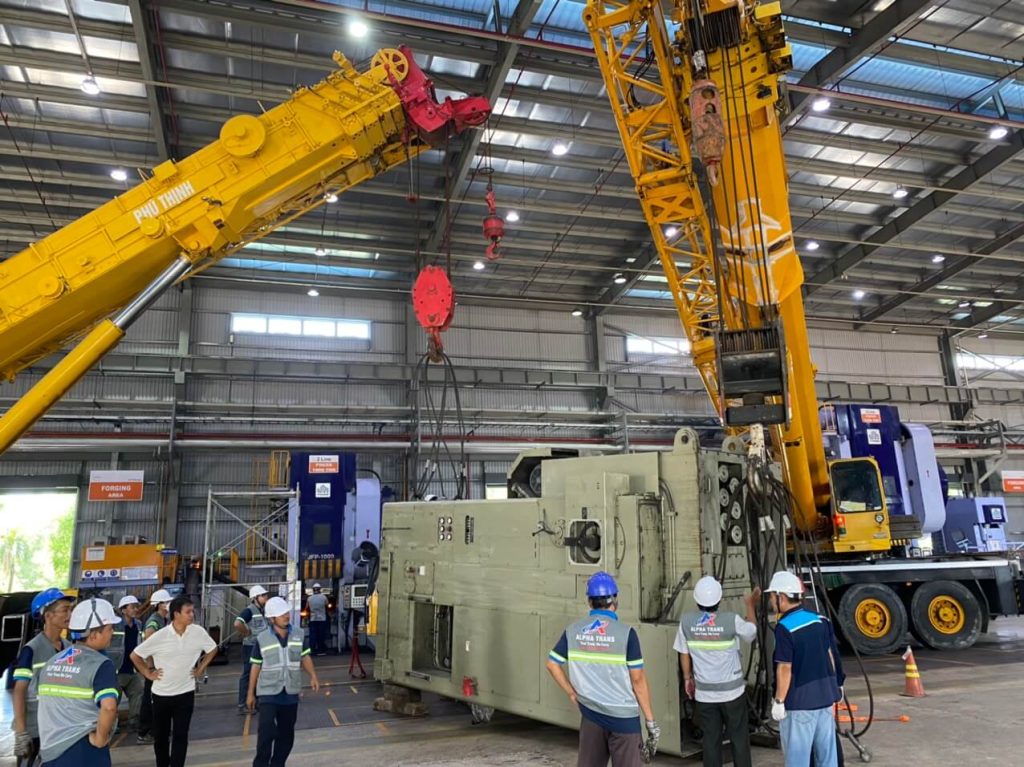
Rotating cold press machine to vertical position during rigging
II. Machine Specifications
| Parameter | Value |
|---|---|
| Manufacturer | THACO (Truong Hai Industrial Machinery Manufacturing JSC) |
| Press force | 49 tons |
| Stroke length | 800 mm |
| Worktable size | 1,200 × 1,000 mm |
| Throat gap | 800 mm |
| Motor power | 55 kW |
| Machine dimensions | 4,500 × 2,500 × 2,800 mm |
| Machine weight | 25 tons |
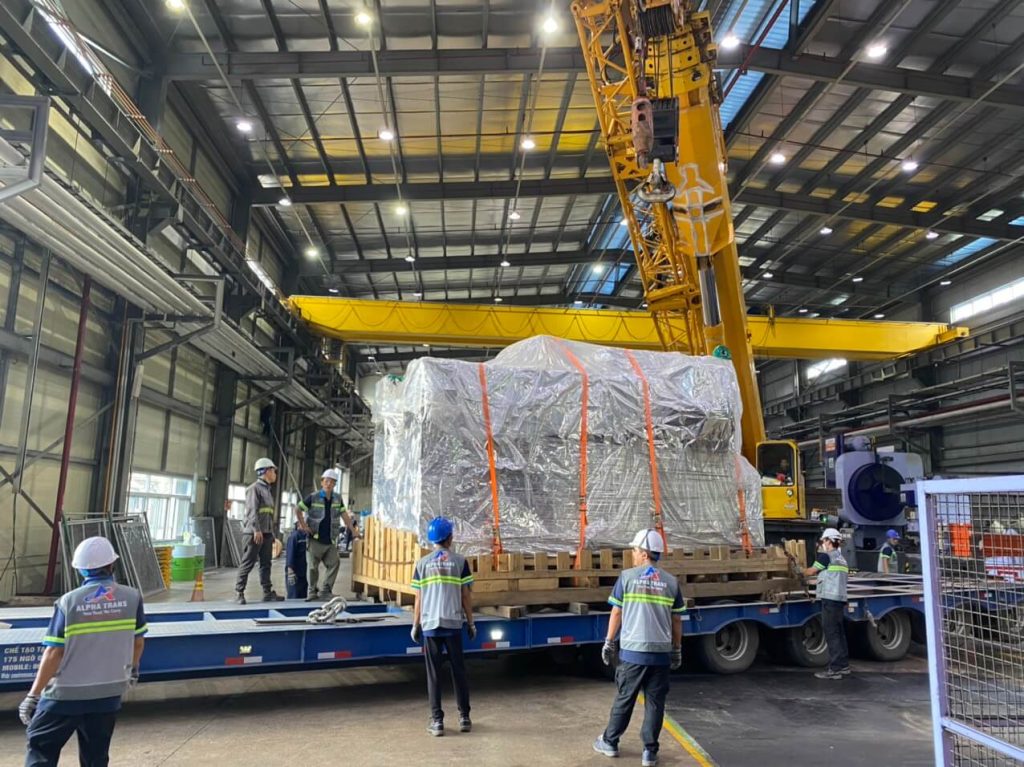
AlphaTrans rigging crew positioning press machine onto factory foundation
III. The Challenge
Three factors made this a rigging job rather than a straightforward delivery:
- Orientation change mid-lift. The press arrived in one orientation and needed to be rotated to vertical before positioning — a maneuver that shifts the load’s center of gravity throughout the lift and requires a calculated rigging plan, not just crane capacity.
- Confined final positioning. Cold press machines are installed to exact alignment against the production line layout — final placement tolerances leave no room for repositioning after the machine is set down.
- Weight and footprint inside an active industrial facility. At 25 tons and 4.5 meters long, the machine’s footprint and floor loading needed to be managed without disrupting the surrounding factory floor.
IV. Our Approach
AlphaTrans handled the job using our standard heavy-lift rigging sequence:
1. Site survey. Our rigging team assessed the delivery point, the indoor route to final position, floor loading capacity, and the exact vertical clearance needed to complete the rotation safely.
2. Lift and rotation plan. Because the machine’s center of gravity moves as it rotates from horizontal to vertical, the lift sequence was calculated and sequenced before any equipment touched the machine — including the rigging points, the rotation method, and the load path.
3. Execution. [Confirm equipment used — e.g., mobile hydraulic crane and rigging turtles from our owned fleet] lifted, uncrated, rotated and moved the press machine along the planned route into the facility.
4. Final positioning and handover. The machine was set onto its foundation at the exact position and orientation required for the production line, with floor protection in place throughout to protect the facility floor. [Confirm: joint inspection/sign-off with the client’s engineering team before handover.]
This sequence mirrors the rigging methodology we apply across our project cargo and machinery installation service — the same process scales from a single press machine like this one to full production-line relocations.
V. Result
The 49-ton cold press machine was lifted, reoriented and installed at Nhon Trach 5 Industrial Zone [confirm: timeframe, e.g. “within a single working day / X hours”] with no damage to the machine or the surrounding facility floor, ready for production line integration.
VI. Why This Matters for Manufacturers Importing or Relocating Heavy Machinery
A cold press machine like this one is a routine job for an asset-backed rigging team — but it illustrates the gap between “we have a crane” and “we can engineer a rotating lift.” For imported machinery in particular, the rigging plan should be considered before the equipment is even crated for shipment: it decides what packing orientation is safe, what road permits the inland leg needs, and what lifting points the crane plan can use on arrival. Our project cargo team reviews these questions from the purchase-order stage, not after the crate lands at the port.
VII.Planning a Machinery Installation or Factory Relocation?
Send us the machine’s weight, dimensions and delivery location — our rigging engineers will confirm the equipment and lift plan before your production schedule is set.
Chief Executive Officer: Mr. TRAN DUC PHU — +84 919 060 101 (Zalo / WhatsApp / WeChat / Viber / Line) — phu@atl.vn


