Shipping between the United States and Vietnam is rarely a matter of booking space and waiting for the cargo to arrive. Certain product categories require an AMS filing before the vessel departs. Others need FDA registration, an MSDS, or a CITES permit. Missing any one of these is the most common reason cargo is held at the port — and the demurrage and detention charges that follow were never in anyone’s budget.
AlphaTrans reviews documentation before cargo leaves the warehouse, specifically to prevent that outcome. We handle the lane end to end, from ocean freight booking through customs clearance in Vietnam and final delivery. This guide covers realistic transit times by port pair, the filings each direction requires, how duty works on a lane with no free trade agreement, and what a complete quotation should contain.
Table of Contents
1. Transit Times by Port Pair
1.1 USA to Vietnam
| Route | Estimated transit |
|---|---|
| Los Angeles / Long Beach – Hai Phong or Ho Chi Minh City | 20–25 days |
| Seattle / Tacoma – Hai Phong or Ho Chi Minh City | 21–26 days |
| Oakland (San Francisco) – Hai Phong or Ho Chi Minh City | 24–29 days |
| Houston – Hai Phong or Ho Chi Minh City | 30–35 days |
| Savannah / Charleston – Hai Phong or Ho Chi Minh City | 32–37 days |
| New York / New Jersey – Hai Phong or Ho Chi Minh City | 34–39 days |
1.2 Vietnam to USA
| Route | Estimated transit |
|---|---|
| Hai Phong or Ho Chi Minh City – Los Angeles / Long Beach | 20–25 days |
| Hai Phong or Ho Chi Minh City – Seattle / Tacoma | 20–25 days |
| Hai Phong or Ho Chi Minh City – Oakland (San Francisco) | 23–28 days |
| Hai Phong or Ho Chi Minh City – Houston | 28–33 days |
| Hai Phong or Ho Chi Minh City – Savannah / Charleston | 30–35 days |
| Hai Phong or Ho Chi Minh City – New York / New Jersey | 32–37 days |
Transit times are port-to-port references and vary with vessel schedule, transshipment, weather and port conditions. Contact us for the current weekly sailing schedule on your lane.
Reading these numbers properly. West Coast ports are ten to fifteen days closer than East Coast and Gulf ports, and that gap is the first thing to weigh when choosing a discharge port. But the shortest sea leg does not always produce the shortest delivery. If your consignee sits in Georgia or New Jersey, a West Coast discharge means the container crosses the continent by rail or truck, adding time and cost that the ocean transit table does not show. We quote the sea leg, the US inland leg and the Vietnamese domestic trucking together so you compare arrival dates, not sailing times.
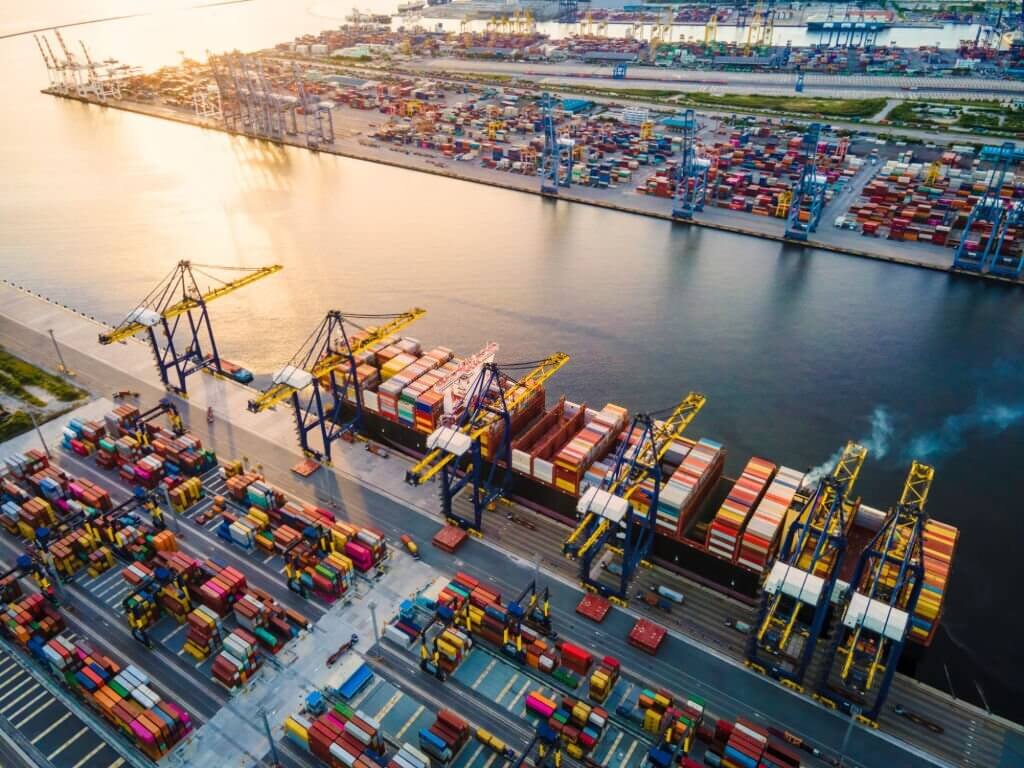
Container ship departing a US West Coast port for ocean freight from the USA to Vietnam
2. Service Options on the USA–Vietnam Route
The right service level depends on the Incoterm you have agreed with your counterparty.
- Door to Door — for cargo bought on EXW or FCA terms. AlphaTrans manages the entire movement from the seller’s warehouse in the USA to the buyer’s warehouse in Vietnam, including inland trucking at both ends, all filings, and customs clearance on both sides.
- Port to Door — for cargo bought on FAS or FOB terms. We collect at the US port and deliver to the door in Vietnam.
- Port to Port — for cargo bought on FAS or FOB terms where you handle customs clearance and inland trucking yourself.
All three are available for both FCL and LCL, in both directions.
- FCL suits shipments above roughly 15 CBM, high-value goods, and cargo that should not be co-loaded.
- LCL is the economical option between 1 and 15 CBM, with consolidation through our partner CFS facilities at the main US gateways. On a long lane like this one, the FCL crossover point tends to sit close to the conventional 15 CBM rule, because the ocean freight component is large relative to the fixed per-shipment charges.
3. Required Filings and Documentation
This is where shipments on this lane go wrong, so it is worth being precise about who files what and when.
3.1 AMS (Automated Manifest System)
Required before the vessel departs for the United States. The carrier files AMS for FCL cargo; the co-loader files it for LCL cargo. The filing is typically made 24 to 48 hours before loading. Late or inaccurate AMS data results in the container being denied loading, or held on arrival.
3.2 ISF (Importer Security Filing, “10+2”)
A separate security filing, and a separate responsibility. ISF is the obligation of the US importer of record, not the carrier, and is generally due no later than 24 hours before the cargo is laden aboard the vessel at the foreign port.
The distinction matters commercially. Many Vietnamese exporters assume their forwarder handles ISF automatically because the forwarder handled AMS. It does not work that way — ISF sits with the US buyer, and penalties for a missing or late filing are assessed against them. We flag this at quotation stage so the two parties agree who is filing before the booking is confirmed, rather than discovering the gap when the vessel is already at sea.
3.3 FDA Registration
Required for specific categories exported to the United States:
- Food products and functional foods
- Dietary supplements
- Pharmaceuticals, prescription and non-prescription
- Vaccines and blood products
- Medical devices
- Electromagnetic radiation-emitting equipment
- Tobacco
- Veterinary-related products
If you are not certain whether your product falls into a regulated category, send us the HS code and product description before booking. Confirming eligibility in advance costs nothing; having a shipment refused at a US port costs a great deal.
3.4 Other Documents
An MSDS is required for chemicals and any cargo with dangerous goods characteristics. A CITES permit applies to products containing protected species — relevant for certain wood and handicraft exports from Vietnam. Wood packaging must meet ISPM 15 heat treatment or fumigation standards in both directions.
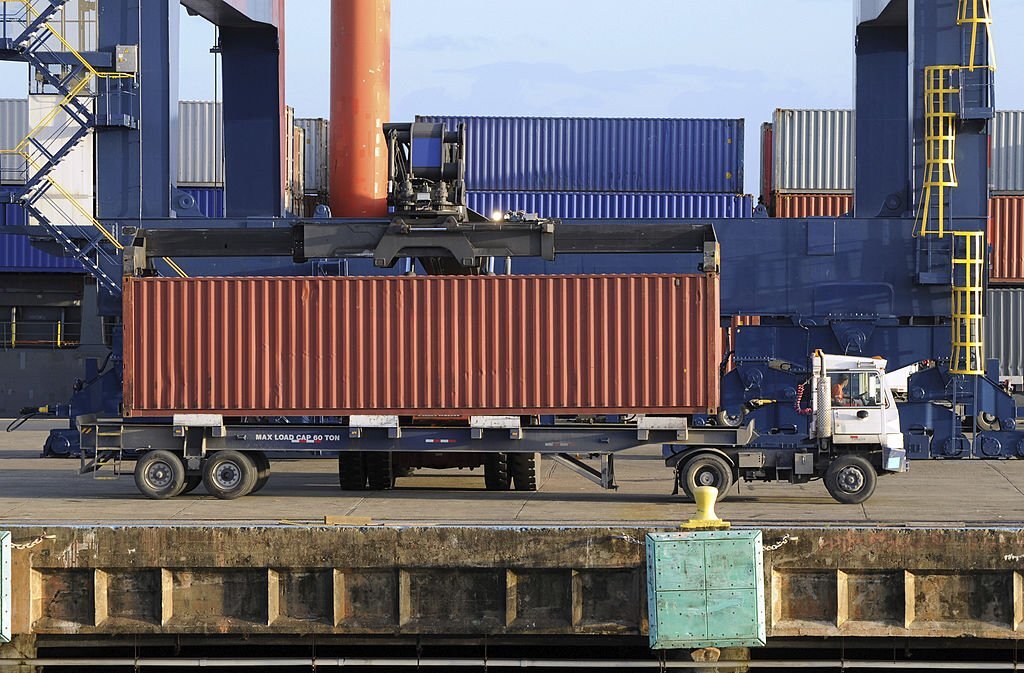
AlphaTrans truck delivering an imported container from the USA to a warehouse in Vietnam
4. Duty and Landed Cost
There is no free trade agreement between Vietnam and the United States. This single fact shapes the economics of the lane in both directions, and it is the most common thing new importers get wrong.
- Importing into Vietnam from the USA. Goods from the United States are assessed at Vietnam’s standard MFN rates. There is no preferential certificate of origin to obtain, and no equivalent of the Form E used on the China lane or Form AK on the Korea lane. Your Vietnamese landed cost is import duty at the MFN rate, calculated on the CIF value, plus VAT on the duty-inclusive total, plus special consumption tax where the commodity attracts it. Importers accustomed to intra-Asian lanes routinely under-budget this by a wide margin.
- Exporting from Vietnam to the USA. US import duty is assessed against the ten-digit HTS classification, which is more granular than the eight-digit HS code used in Vietnam. The same physical product can fall into different HTS lines depending on material composition, construction or intended use, and the duty consequences of that distinction can be significant. Additional trade measures may apply on top of the base rate depending on the commodity and the prevailing policy environment. Merchandise Processing Fee and Harbor Maintenance Fee apply separately.
US tariff policy toward Vietnamese goods has been revised repeatedly in recent years, and published rates go stale quickly. Rather than quote figures that may be outdated by the time you read them, we verify the current rate against your specific HTS classification at the time you request a quotation. Send the HS code and a product description and we will confirm the applicable duty before you commit to a purchase order.
5. How a Shipment Runs
- Quotation. Provide commodity, volume, dimensions, weight, Incoterms and shipper/consignee details. We check rates with our US agents and return the estimated schedule, reference duty, and guidance on any import or export restrictions applying to your commodity.
- Booking confirmation. We coordinate with the US agent for imports, or the Vietnamese shipper for exports, and confirm the schedule.
- Filings. AMS is arranged before departure. We confirm in writing who is filing ISF. FDA registration is verified where the commodity requires it.
- Bill of Lading. Issued for your review and confirmation before the vessel sails.
- Transit and tracking. Milestone updates, with immediate notice of any schedule change.
- Arrival. For imports, we issue the arrival notice, complete Vietnamese customs clearance and deliver to your warehouse. For exports, we confirm the bill of lading type — surrendered or original — with the US agent and notify cargo release.
6. Commodities on the USA–Vietnam Lane
| Direction | Main categories |
|---|---|
| Vietnam → USA | Garments and footwear, wooden furniture, electronics and components, seafood, cashews and coffee, plastic products |
| USA → Vietnam | Industrial machinery and equipment, plastic resin and chemicals, raw cotton and textile inputs, animal feed and agricultural commodities, medical devices, pharmaceuticals |
7. Carriers and US Agents
We book with the major carriers serving this lane, including MSC, CMA CGM, COSCO, OOCL, Wan Hai, MOL and Hapag-Lloyd, and work with a network of US-based agents handling inland trucking to and from the buyer’s or seller’s warehouse. Bookings are tracked end to end, with prompt notice of any schedule change.
8. Why Shippers Use AlphaTrans on This Lane
Documentation is checked before departure, not after arrival. On a 20 to 39 day transit, an error discovered at destination cannot be fixed cheaply. Our team reviews the filing set while corrections are still free.
Customs clearance in Vietnam is in-house. Our licensed brokerage files more than 10,000 declarations a month at Cat Lai, Cai Mep, Hai Phong and the main airports. The person who answers a customs query is the person who filed the declaration.
We own the domestic leg. 65 tractor units and 200 chassis mean the Vietnam-side trucking is not subcontracted — which matters most in the weeks before Tet, when hired capacity becomes scarce and expensive.
Quotes are itemised. Ocean freight, origin charges, destination charges and estimated duty appear as separate lines. On a lane with no FTA preference, an accurate duty estimate at quotation stage is the difference between a profitable shipment and a surprise.
9. Frequently Asked Questions
Q1: What is the difference between AMS and ISF?
AMS is the manifest filing, submitted by the carrier for FCL cargo or by the co-loader for LCL, before the vessel departs. ISF is a separate security filing and is the responsibility of the US importer of record, generally due at least 24 hours before loading at the origin port. They are different filings with different filers and different penalties. Missing either can result in the cargo being held or fined.
Q2: Does my cargo need FDA registration?
Only specific categories require it — food, pharmaceuticals, medical devices, dietary supplements, tobacco, radiation-emitting equipment and veterinary products among them. If you are unsure whether your product qualifies, send us the HS code and product description and we will confirm before booking.
Q3: Which US port gives the shortest transit time?
West Coast ports — Los Angeles/Long Beach, Seattle/Tacoma and Oakland — are consistently the fastest from Vietnam at 20 to 28 days. East Coast and Gulf ports add roughly ten to fifteen days. If the final destination is inland or on the East Coast, ask us to compare total delivered time rather than port-to-port transit, because US inland movement can erase the West Coast advantage.
Q4: Does Door-to-Door service include customs clearance?
Yes. Under Door-to-Door, AlphaTrans manages inland trucking at both ends, arranges the required filings, handles customs clearance in Vietnam through our own brokerage and through our agent in the United States, and delivers to the final warehouse.
Q5: Is there a free trade agreement between Vietnam and the USA?
No. Unlike the China lane, where Form E delivers 0% duty on most tariff lines, or the Korea lane with Form AK and VK, there is no preferential certificate of origin available on the US–Vietnam route. Goods are assessed at standard rates in both directions. This is the single most common budgeting error made by importers moving from intra-Asian sourcing to US suppliers.
Q6: How far in advance should I book?
Two to three weeks before your cargo ready date for standard FCL, and slightly longer during peak season — August through October for US-bound holiday inventory, and the four weeks before Tet for Vietnam-bound cargo. On a lane this long, space is not the constraint so much as documentation lead time. Bookings that go wrong almost always go wrong because filings were rushed.
Q7: Can you handle shipments requiring both FDA registration and dangerous goods documentation?
Yes. Cargo needing both — certain pharmaceutical and chemical products, for example — requires the filings to be coordinated rather than handled separately, because the classification driving one affects the other. Send the product specification and safety data sheet and we will map the full requirement set before booking.
10. Get a USA – Vietnam Quote in 15 Minutes
Send us four things and we will return a complete, itemised quotation: