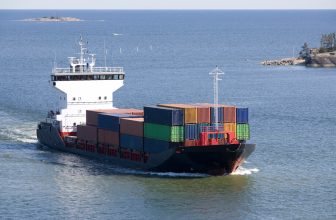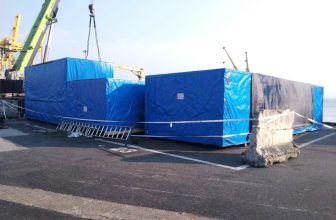
The China–Vietnam corridor remains Vietnam’s busiest trade lane, with bilateral trade now exceeding US$200 billion a year. Whether you are importing components from Shenzhen or exporting finished goods to Shanghai, choosing the right ocean freight setup directly decides your landed cost and lead time.
AlphaTrans has moved containers on this lane since 2016. With our own fleet of 65 tractor trucks, in-house customs clearance in Vietnam, and weekly space allocations with COSCO, Maersk, MSC and Evergreen, we run the route door to door. This guide covers rates, transit times, ports, and how to legally reach 0% import duty in 2026.
Table of Contents
1. The China–Vietnam Trade Landscape in 2026
Three shifts define the corridor this year.
- High-tech and component flows have overtaken raw materials. Electronics, precision machinery and semiconductor components now move at high frequency between Shenzhen and Shanghai and the industrial zones of Bac Ninh, Hai Phong, Binh Duong and Dong Nai. These shipments are smaller, more frequent, and far more sensitive to delay than the bulk cargo that dominated the lane five years ago.
- Duty optimisation has become standard practice, not an advantage. Under ACFTA and RCEP, most tariff lines qualify for 0% import duty with a valid Certificate of Origin. Nearly every serious importer now claims it. What separates a smooth clearance from a stuck container is no longer whether you use Form E, but whether the form is error-free before the vessel departs.
- Short transit has made local charges the real cost variable. On a two-to-four day Hai Phong–Shenzhen run, ocean freight is often less than 60% of what you actually pay. The rest sits in terminal handling, container imbalance charges, delivery order fees and — when clearance goes wrong — demurrage. A quote that shows only the ocean rate tells you very little.
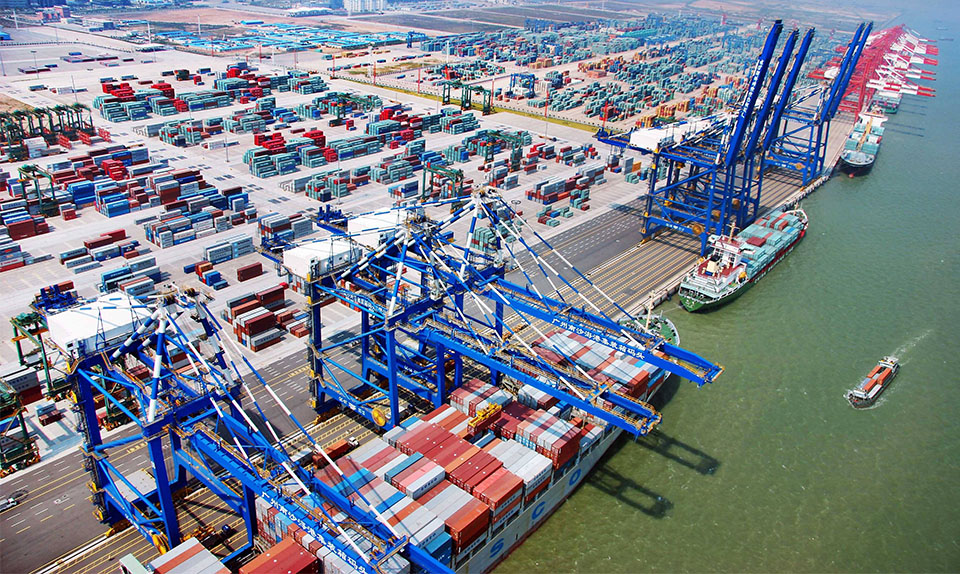
LCL and FCL ocean freight services to China and china to vietnam
2. 2026 Shipping Rates and Transit Schedules
2.1 FCL — Vietnam to China (Export)
| Route | 20’DC (USD) | 40’HC (USD) | Transit |
|---|---|---|---|
| Hai Phong – Shenzhen / Guangzhou | 400 – 550 | 600 – 750 | 2–4 days |
| Hai Phong – Shanghai / Ningbo | 550 – 750 | 800 – 1,050 | 4–6 days |
| HCMC / Cai Mep – Shenzhen | 600 – 800 | 850 – 1,100 | 5–7 days |
| HCMC / Cai Mep – Shanghai | 750 – 950 | 1,000 – 1,300 | 8–10 days |
| Da Nang – Ningbo | 950 – 1,250 | 1,400 – 1,700 | 9–11 days |
2.2 LCL — China to Vietnam (Import)
| Route | Per CBM (incl. THC) | Departures | Transit |
|---|---|---|---|
| Shenzhen – Hai Phong | 18 – 30 USD | Tue / Thu / Sat | 4 days |
| Shanghai – Hai Phong | 22 – 35 USD | Mon / Wed / Fri | 6 days |
| Shanghai – HCMC | 30 – 45 USD | Mon / Wed / Fri | 9 days |
| Ningbo – HCMC | 32 – 48 USD | Weekly | 10 days |
Rates last reviewed: July 2026. These are ocean freight ranges only and exclude destination local charges (see Section 4). Actual pricing moves with peak season, bunker surcharges, equipment availability and space conditions. For a live quote itemising every line, call +84 919 060 101.
Why we publish ranges rather than fixed numbers. Container rates on this lane routinely move 20–40% within a single quarter. A forwarder quoting one hard number in a web page is either working from stale data or will revise it the moment you book. The ranges above reflect what we have actually booked over the past quarter, and we review them every January, April, July and October.
3. Key Ports on the China–Vietnam Route
| Country | Main international ports | Typical cargo |
| China | Shanghai, Shenzhen, Ningbo-Zhoushan, Qingdao | Electronics, machinery, raw materials, industrial components |
| Vietnam | Hai Phong (Lach Huyen), Da Nang, Cat Lai (HCMC), Cai Mep | Agricultural products, textiles, finished electronics, footwear |
Port pairing is the single biggest lever on your total cost, and most shippers get it wrong by defaulting to whichever port their supplier suggests.
A factory in Bac Ninh importing from Shenzhen through Cat Lai pays for a five-to-seven day sea leg plus roughly 1,700 km of domestic trucking. The same cargo through Hai Phong is a two-to-four day sea leg and under 120 km of trucking. The ocean rate to Cat Lai may look competitive in isolation; the delivered cost is not close.
Conversely, an importer in Binh Duong routing through Hai Phong to chase a cheap ocean rate loses everything gained to a two-day domestic haul with much greater exposure to schedule risk.
We advise the port pair based on where your factory or warehouse actually sits, and we quote the container trucking leg in the same quotation so you can compare delivered cost rather than ocean rate.
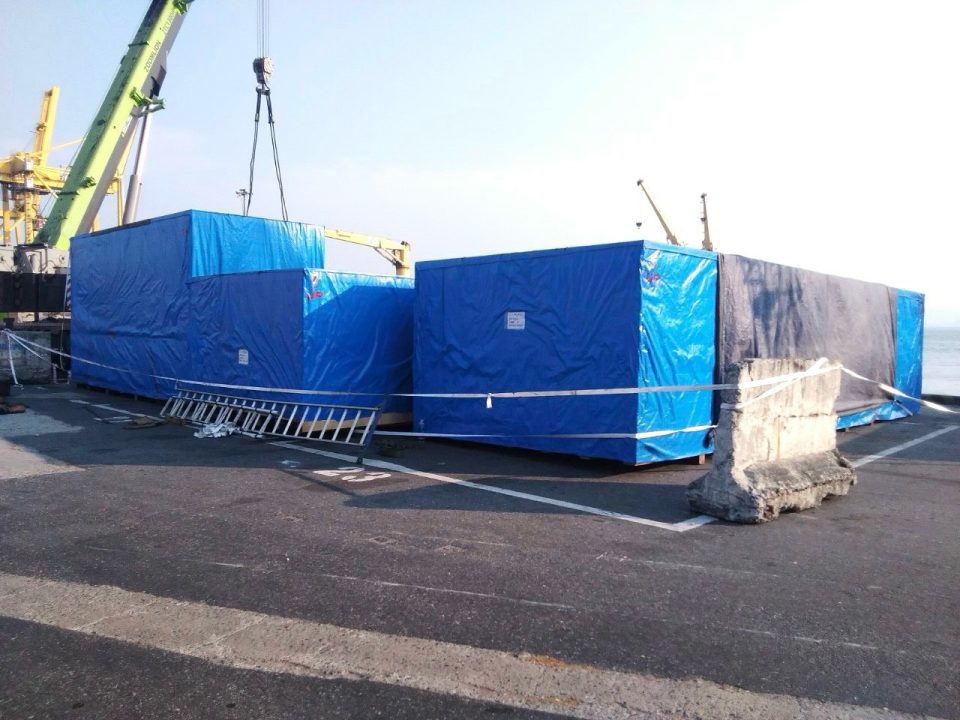
AlphaTrans container truck handling ocean freight from China to Vietnam at Cat Lai Port
4. FCL and LCL Services on This Lane
4.1 FCL (Full Container Load)
Suited to shipments above roughly 15 CBM, high-value goods, and cargo that must not be co-loaded with other shippers’ freight.
- Equipment: 20’DC, 40’DC, 40’HC, 45’GP, plus reefers for cold-chain cargo
- Service modes: Door-to-Door (DAP/DDP), Port-to-Door, Door-to-Port, Port-to-Port
- Both directions on every port pair listed in Section 2
4.2 LCL (Less than Container Load)
The economical option between roughly 1 and 15 CBM. You pay only for the volume your cargo occupies.
- Consolidation: fixed weekly departures via our partner CFS facilities in Shanghai, Shenzhen and Ningbo
- Cost control: quotations itemise ocean freight and destination local charges upfront, so the CFS and D/O fees are visible before you book, not after arrival
Choosing between them. The usual rule of thumb is 15 CBM, but on this lane the crossover is often lower than shippers expect. Because FCL rates ex-South China are relatively cheap and LCL carries fixed per-shipment charges regardless of volume, a 12–13 CBM shipment from Shenzhen to Hai Phong sometimes lands cheaper in a 20′ container than as LCL. Send us your volume and we will run both.
For the neighbouring corridor, see our Hong Kong–Vietnam ocean freight page, which operates under Form AHK rather than Form E. Our full network is on the international sea freight services page, and for urgent components we also run air freight from China with one-to-two day options.
5. Form E and RCEP: Getting to 0% Duty
Most tariff lines from China qualify for 0% import duty into Vietnam under the ASEAN–China Free Trade Area (ACFTA) using Certificate of Origin Form E, or under RCEP using the RCEP certificate of origin.
5.1 Which Form to Use
| Form E (ACFTA) | RCEP C/O | |
|---|---|---|
| Coverage | Broad; 0% on most lines | Broad, but some lines phase in over time |
| Cumulation | China–ASEAN only | All 15 RCEP members — useful for multi-country inputs |
| Familiarity | Long-established; well understood by Vietnamese customs | Newer; occasionally slower at some checkpoints |
| Best for | Goods wholly produced in China | Goods with inputs from Japan, Korea or other RCEP members |
For most straightforward shipments, Form E is the simpler route. RCEP earns its place when your goods contain material from several member countries — commonly inputs from Korea or Japan — and would fail the ACFTA regional value content test on its own. Send us your HS code and bill of materials and we will compare both before you ask your supplier for a certificate.
5.2 The Errors That Cost You the Preference
Every one of these has held up a shipment on this lane:
- Consignee name or address differs from the bill of lading — even a missing “Co., Ltd” can trigger a query
- Issue date after the vessel departure date — the certificate must not post-date the shipment
- Wrong origin criterion in Box 8 — the criterion must match how the goods actually qualify
- Invoice number mismatch between the C/O and the commercial invoice
- Third-party invoicing not declared where the invoice is issued by a company outside China
We check the draft certificate against the draft bill of lading and commercial invoice before the supplier finalises anything. A correction at draft stage takes ten minutes; a reissued certificate after arrival takes five to ten working days with demurrage accruing throughout.
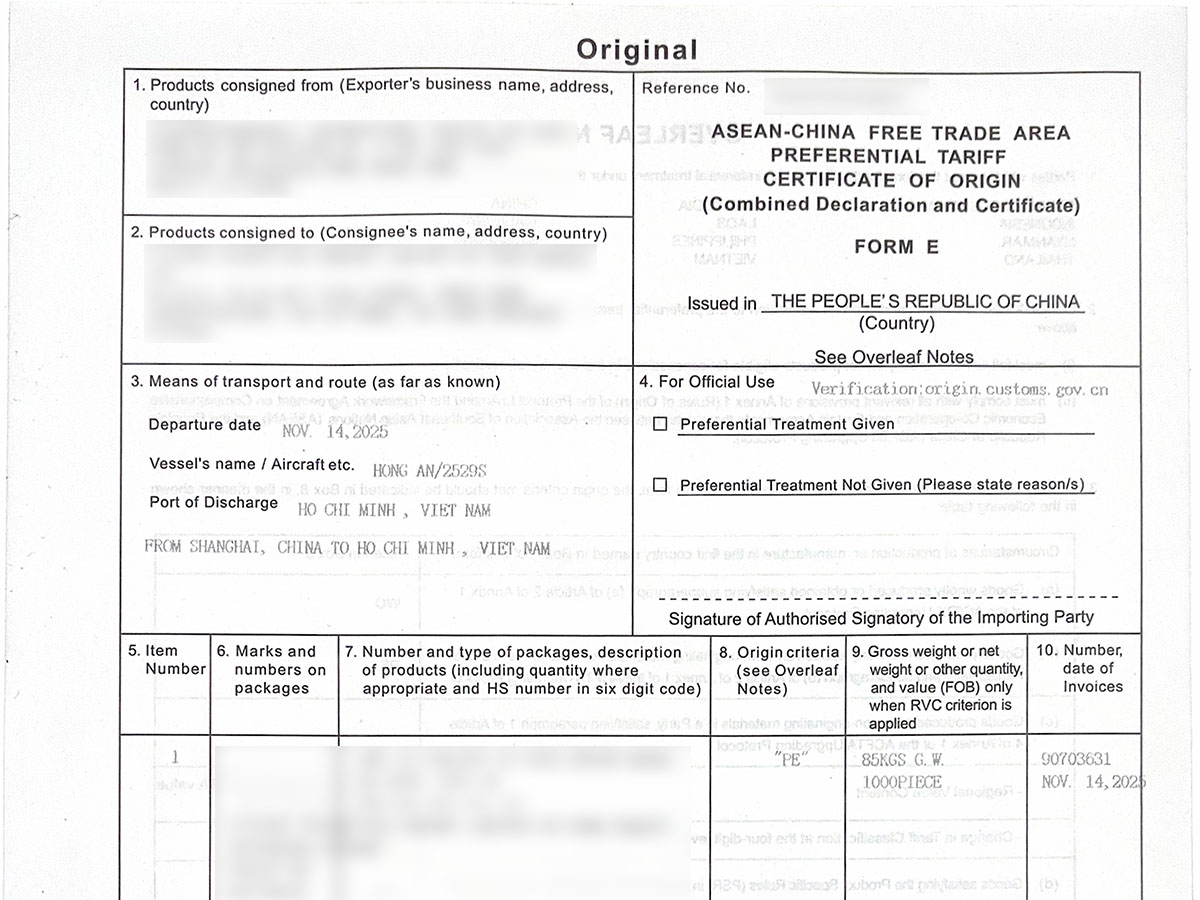
Certificate of Origin Form E used to claim 0% import duty on goods from China to Vietnam
6. Step-by-Step Process and Customs Clearance
- Inquiry & quotation — you provide cargo dimensions, weight, HS codes and Incoterms (FOB, EXW, CIF…); we issue a transparent quote.
- Booking — we secure container space matching your delivery timeline.
- Pick-up & packing — collection from your factory, or receipt at a CFS hub for consolidation.
- Export customs clearance — our brokerage team handles documentation, permits and declarations.
- Ocean transit — cargo is tracked with milestone updates throughout the voyage.
- Import clearance & delivery — we manage duties, clear customs and truck the cargo to your warehouse.
The full range of routes we operate beyond China is covered on our international sea freight services page; for the neighboring lane, see Hong Kong–Vietnam ocean freight.
7. Commodities on the China–Vietnam Lane
| Direction | Main categories |
|---|---|
| China → Vietnam | Electronic components and integrated circuits, industrial machinery and spare parts, plastic resin and chemicals, fabric and textile accessories, steel and construction materials, fertilizer |
| Vietnam → China | Agricultural products (fruit, cashew, coffee, rice), seafood, footwear and garments, wooden furniture, rubber, assembled electronics |
8. Why Importers Use AlphaTrans on This Lane
- We own the trucks. 65 tractor units and 200 chassis mean the domestic leg is not subcontracted to whoever is available — which matters most in the weeks before Tet and Golden Week, when hired capacity disappears.
- Customs is in-house. Our licensed brokerage files more than 10,000 declarations a month. When customs raises a query at 9pm before a cut-off, the person answering is the person who filed it.
- Quotes are itemised. Every origin and destination charge appears on the quotation. The quoted price is the invoiced price.
- Document review happens before departure. We check the Form E while it can still be corrected cheaply.
- Offices at both ends of the domestic leg. Hai Phong, Hanoi, Da Nang, HCMC, Binh Duong and Dong Nai — so cargo is handled by our staff, not a chain of agents.
9. Frequently Asked Questions (FAQ)
Q1: How long does ocean freight from China to Vietnam take?
It depends on the port pair. To Southern Vietnam (HCMC/Cai Mep), allow 7–10 days from Shanghai/Ningbo and 3–5 days from Shenzhen. To Hai Phong, only 2–4 days from South China ports. Add 2–3 days for customs clearance and local trucking on a door-to-door basis.
Q2: What documents are required for sea freight between Vietnam and China?
A standard set: Commercial Invoice, Packing List, Bill of Lading (B/L), Certificate of Origin (crucial for tariff preference), export license where applicable, and phytosanitary/health certificates for agricultural or food products.
Q3: How can I get 0% import duty on shipments from China in 2026?
Under ACFTA and RCEP, most tariff lines qualify for 0% duty with a valid Certificate of Origin Form E. Request the digital e-Form E from your Chinese supplier before the vessel departs — it verifies instantly with Vietnam Customs and avoids costly delays.
Q4: When should I choose LCL over FCL?
Choose LCL below roughly 15 CBM — you share container space and pay only for your volume. Above 15 CBM, a full 20’ container (FCL) is usually cheaper and faster.
Q5: Are there hidden fees I should watch for?
“Hidden” costs usually appear at destination: THC, cleaning fee, CFS fee (LCL), CIC, customs brokerage, and Demurrage/Detention (DEM/DET) if cargo overstays its free time. AlphaTrans quotes are 100% itemized so there are no surprises.
Q6: What happens if Vietnam Customs rejects my Form E?
The shipment still clears, but at the standard MFN rate rather than 0%. You can pay the duty or lodge a guarantee to release the cargo, then claim a refund once a valid certificate is presented. Vietnamese regulations allow a supplementary Certificate of Origin to be submitted within one year of the customs declaration date. We handle this process on the customer’s behalf so production is not held up while the paperwork is corrected.
Q7: Do you handle imports of used machinery from China?
Yes. Used machinery is subject to additional inspection requirements in Vietnam relating to equipment age and applicable standards, and it is one of the categories most likely to be held for physical inspection. We advise on eligibility before you commit to a purchase order rather than after the container arrives.
10. Get a Transparent China–Vietnam Quote Within 15 Minutes
Send us four things and we will quote in full:
① Port pair (or your factory and warehouse locations) ② Commodity and HS code, if known ③ Volume in CBM or container count ④ Cargo ready date